

Introduction
What if the key to stronger rural economies is not simply growing more crops, but finding new ways to use the crops farmers already produce?
This question sits at the heart of rural development around the world today. For many farming communities, the greatest economic opportunity lies not only in producing crops, but in discovering new ways to process, transform, and market them. When farmers can add value to what they grow, agriculture becomes more than subsistence, it becomes a pathway to resilience, entrepreneurship, and long-term prosperity.
More than a century ago, one scientist devoted his life to demonstrating exactly that principle.
George Washington Carver is widely remembered for his work with peanuts. Yet the deeper legacy lies in the agricultural innovation pioneered by George Washington Carver, showing how ordinary crops could be transformed into hundreds of useful products and entirely new economic opportunities. His insights continue to shape agricultural development thinking today.
George Washington Carver and Agricultural Innovation
In today’s language, George Washington Carver might even be considered the G.O.A.T.—the “greatest of all time”—when it comes to agricultural value addition. Long before economists spoke about agricultural value chains or rural agro-processing industries, Carver was already demonstrating a simple but powerful idea: farmers should not stop at producing raw crops.
The real opportunity lies in transforming those crops into products with greater economic value.
Working at the Tuskegee Institute, Carver showed that crops such as peanuts and sweet potatoes could be turned into hundreds of useful products, from food ingredients and cooking oils to dyes, soaps, paints, and industrial materials.
Historical records show that Carver identified:
- More than 300 products derived from peanuts
- 118 products from sweet potatoes
Many of these discoveries are preserved in the archives of the USDA National Agricultural Library.
By demonstrating how everyday crops could be transformed into a wide range of useful products, Carver helped create entirely new markets for farmers. In doing so, he laid the groundwork for what we now call value-added agriculture, an approach that allows farmers and rural communities to capture more of the economic value created along the agricultural chain.
The Agricultural Crisis Carver Faced
When Carver arrived at the Tuskegee Institute in 1896 at the invitation of Booker T. Washington, agriculture across the American South was in crisis.
For decades, farmers had relied almost entirely on cotton. Continuous cotton cultivation had depleted soil nutrients, leaving fields exhausted and yields declining. Many farmers, especially Black tenant farmers and sharecroppers, were trapped in cycles of debt and soil degradation.
Carver’s first priority was restoring soil fertility. His solution was crop rotation, encouraging farmers to alternate cotton with nitrogen-fixing legumes such as peanuts, cowpeas, and sweet potatoes. These crops naturally replenish soil nutrients and help rebuild agricultural productivity.
According to the National Park Service, Carver’s soil restoration strategies helped farmers gradually rebuild exhausted farmland while diversifying what they grew.
But solving one problem created another. Farmers who followed Carver’s advice soon had large harvests of peanuts and sweet potatoes, but almost no markets to sell them.
Seeing Opportunity Where Others Saw Surplus
Carver realized that agricultural change required more than better farming practices. Farmers also needed new economic uses for the crops they produced.
Working in his laboratory at Tuskegee, Carver began systematically investigating how common crops could be transformed into useful products. His approach was remarkably modern: he separated crops into their chemical components—oils, starches, proteins, and fibers—and explored how each could be used.
Examples included:
Food products
- Peanut flour
- Peanut milk
- Cooking oils
- Coffee substitutes
Industrial uses
- Soap
- Shampoo
- Lubricants and axle grease
Paints and dyes
- Wood stains
- Printer’s ink
Carver’s goal was simple: increase the economic value of crops farmers could already grow successfully.
The Peanut as a Case Study in Value Addition
The peanut became Carver’s most famous research subject, not because it was fashionable, but because it was practical.
Peanuts restored nitrogen to depleted soils and provided a nutritious source of protein and oil. But without processing, they had limited market demand.
Carver’s research transformed the peanut from a marginal crop into a foundation for new industries. In 1921 he famously testified before the United States House of Representatives, demonstrating dozens of peanut-based products and advocating policies that supported the emerging peanut sector. This transformation illustrated a crucial lesson: when farmers move beyond selling raw commodities and begin transforming them into products, entire agricultural economies can change.
A Lesson for Kenya: The Untapped Potential of Sweet Potatoes
One of the crops that fascinated George Washington Carver most was the sweet potato. Through careful experimentation, he identified more than 100 products derived from sweet potatoes, including flours, starches, dyes, adhesives, and a variety of food products.
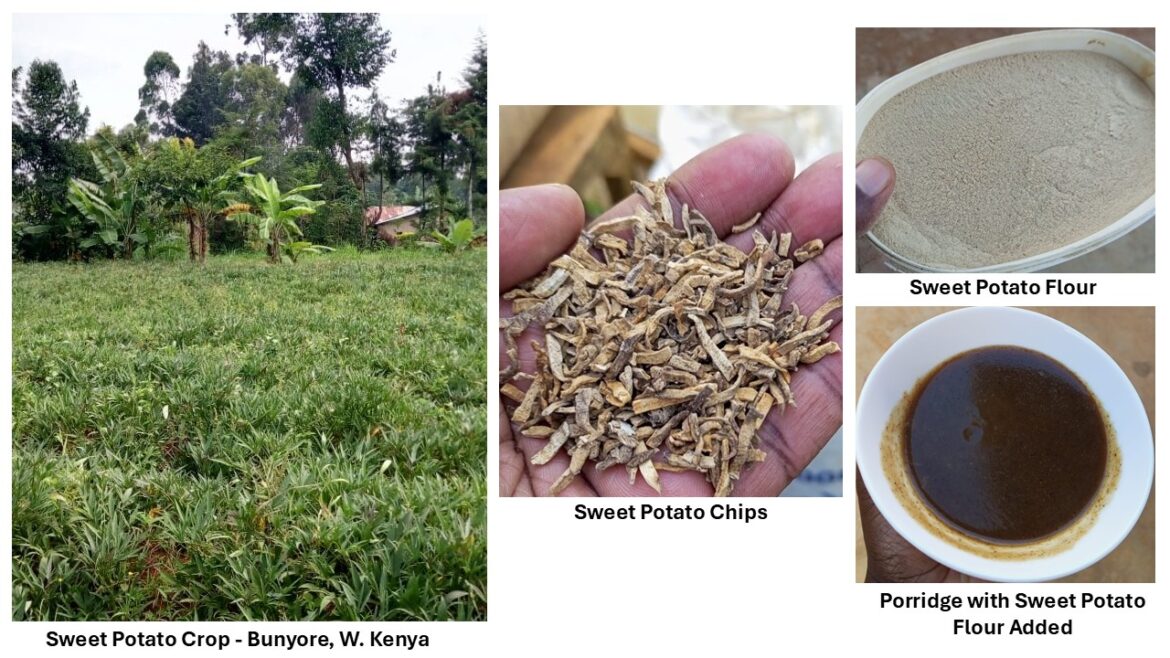
Today, Kenya shows how the same principle of George Washington Carver value-added agriculture—transforming crops into new products and markets—can create opportunities for farmers and rural communities.
Sweet potatoes are widely grown in Kenya. They are valued for:
- Resilience: They grow well even in poor soils.
- Short production cycle: Some varieties mature in 3–4 months.
- Income potential: Farmers can generate both food and cash quickly.
Yet most sweet potatoes are still sold as fresh roots. This means farmers capture only a small share of the crop’s potential value.
Processing innovations are beginning to change this. Researchers at the International Potato Center have promoted the use of orange-fleshed sweet potato (OFSP) purée in bakery products. The purée can replace 30–60 percent of wheat flour, reducing costs while increasing nutritional value because OFSP is rich in beta-carotene, a precursor of vitamin A.
Other technologies are helping bakeries and small enterprises extend the shelf life of sweet potato purée. This allows farmers to supply products such as:
- Bread and buns
- Porridge and baby foods
- Snack items
These innovations create new markets and opportunities for rural processing businesses.
In western Kenya, organizations such as Mwandani International support farmers to strengthen livelihoods and capture more value from their crops.
These developments echo Carver’s insight from more than a century ago: the true economic potential of agriculture emerges when crops are transformed into new products, markets, and opportunities for communities.
Conclusion
The work of George Washington Carver reminds us that agriculture has always been about more than producing crops. At its best, it is about unlocking the hidden potential within the land, the harvest, and the people who depend on both.
More than a century ago, Carver demonstrated that the path to stronger rural economies often begins with a simple but powerful insight: the farm produces raw materials, but value addition creates opportunity.
At Mwandani International, we see that same potential in the farmers and communities we work alongside in western Kenya.
More than a hundred years later, Carver’s legacy continues to remind us that innovation in agriculture often begins not with new land or new crops, but with new ways of seeing the possibilities within what farmers already grow.
And when those possibilities are realized, agriculture becomes not only a source of food, but a foundation for dignity, opportunity, and hope in rural communities.
Learn more about our work at https://www.mwandani.org
Explore more stories and insights at https://www.mwandani.org/blog/