

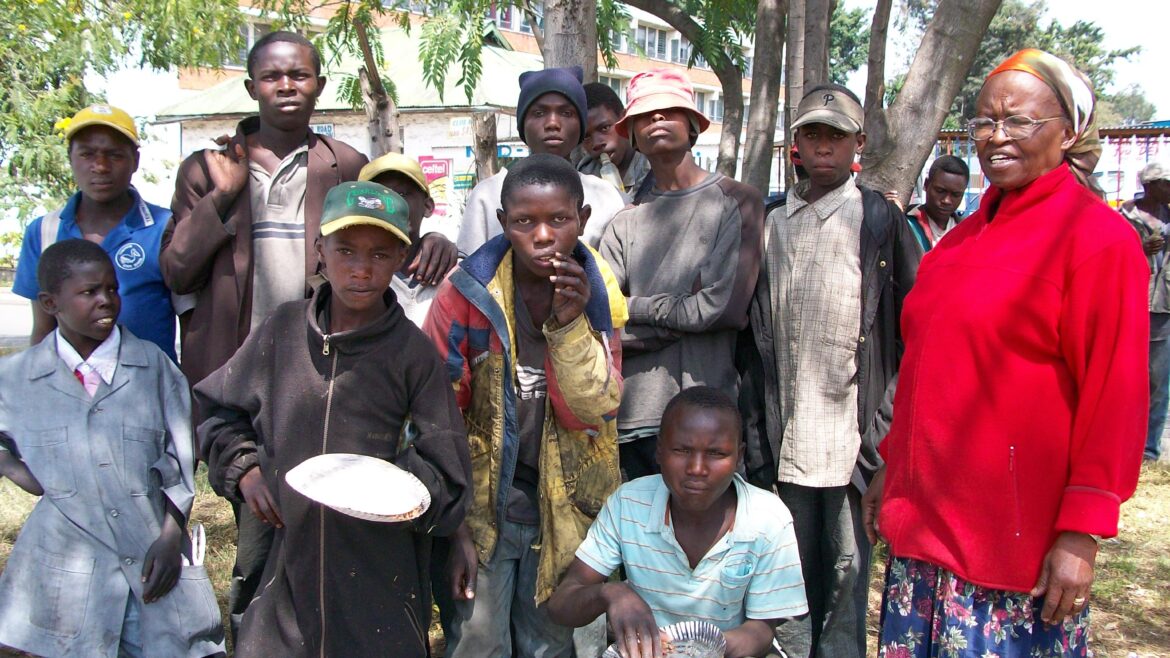
“When you feed a hungry child, you nourish more than a body, you restore dignity.”
— Niva Kegode, 1980s, Nakuru, Kenya
A Legacy Born from Compassion
In the 1980s, Niva Kegode saw something few dared to look at directly: a growing number of children living on the streets of Nakuru. Armed with faith and compassion, and little else, she began a small ministry to feed them and provide for their most basic needs.
It wasn’t an organization, nor was it backed by major funding. It was simply a mother’s heart responding to the suffering before her eyes, one meal, one conversation, one act of kindness at a time.
Her hope was that as Kenya developed, the problem of street children and urban homelessness would decline. But that did not happen. The numbers grew, not only in Nakuru but across the country, revealing that hunger and homelessness were symptoms of deeper, systemic issues.
For instance, recent government census data show that thousands of “street families” are being counted and that youth and children make up a large portion of that population (Kenya News Agency).
Lessons from a Generation of Compassion
Niva Kegode’s work taught us a vital truth: charity alone cannot solve the problem of homelessness. Feeding the hungry remains an act of love, but lasting change requires transforming the conditions that create hunger and displacement in the first place.
Today, Kenya continues to face an alarming rise in urban homelessness, much of it linked to rural-to-urban migration. Families and youth leave rural areas, seeking opportunity in cities that cannot absorb them. Without stable income, housing or social support, many end up on the streets, continuing the cycle Niva Kegode tried so hard to break.
Studies show, for instance, that the phenomenon of street-connected children in Kenya remains significant, with estimates of 250,000–300,000 children living and/or working on the streets (Rescue Dada Centre).
Value-Addition: From Raw Produce to Rural Prosperity
Agriculture remains foundational to rural livelihoods across Kenya. The agricultural sector employs the majority of rural inhabitants and plays a vital role in poverty reduction, according to Ministry of Agriculture, Government of Kenya.
Yet too often, farmers sell raw produce at low prices, suffer high post-harvest losses, and see limited reason to stay in the countryside. That’s where value-added agriculture becomes transformative. By processing, refining, packaging, and marketing agricultural products, rather than simply selling raw outputs, rural families can unlock substantially higher income, access wider markets, create meaningful livelihoods in-place rather than seeking survival in cities.
In Kenya, initiatives like the Kenya Agricultural Value Chain Enterprises (KAVES) project have helped link smallholder farmers to buyers across multiple value chains (including sweet potato, banana, pulses, groundnut) and thereby increased productivity, market access and incomes (Farm Concern International).
Additional research finds that value addition is one of the most promising undertakings for small-farmers to improve their rural livelihoods (Ntale, Litondo, & Mphande, 2014).
For example:
- Value-chain focused programs in Kenya show that when farmers engage in processing and marketing rather than just production, poverty and income inequality decline (Adhiambo, Onyango, & Mogwambo 2017).
- Studies highlight that agriculture value chains are “pivotal for economic development in Africa” and that adding value boosts farmer incomes and competitiveness (AgriFrontier).
At Mwandani International we align directly with these insights. Our approach is to help rural Kenyan farmers and families stay rooted, earn more, and build stable futures, not by making farming a fallback, but by making it a viable, dignified pathway.
From Feeding to Empowering: The Mwandani International Approach
Where Niva Kegode fed the hungry with what little she had, we at Mwandani International now seek to empower before hunger begins.
Our strategy is built on three interlinked components:
- Value-added agriculture – supporting rural entrepreneurs to turn raw crops into market-ready products that command higher prices and open broader markets.
- Training & youth empowerment – encouraging young Kenyans to see agriculture as a career path, offering mentorship, skills and opportunities so that they stay in the community rather than migrate.
- Women’s empowerment & community leadership – collaborating with rural women’s groups and local leadership so that change is built with communities, not for them.
In doing so, we take the compassion-driven legacy of my mother and evolve it into a sustainable model of resilience. One that addresses not just the immediate need of feeding children, but the root drivers of rural poverty, migration, and urban homelessness.
Hope That Multiplies
At the core of both Niva Kegode’s work and Mwandani International’s mission lies the same conviction:
Every person deserves dignity, opportunity and a place to call home.
Her feeding program may not have stopped homelessness, but it planted a seed: the belief that no challenge is too great when we care deeply enough to act. That seed continues to grow through Mwandani International’s programs in value-added agriculture, women’s empowerment, youth mentorship, and community-driven change. Each project is a continuation of her vision, proof that love plus action, when rooted in purpose, can span generations.
Carrying the Legacy Forward
As Mwandani International continues to evolve, we do so in memory of Niva Kegode’s compassion and in commitment to her dream, that no child should have to sleep hungry or homeless.
But we now know that feeding hope means creating opportunity. That lasting impact grows not just from what we give, but from what we empower others to build.
Through our collaborations with rural farmers in western Kenya and beyond, we aim to stop homelessness before it begins, turning lessons from the past into the foundation for a more stable, self-reliant future.
From Niva Kegode’s hands to Mwandani International’s mission — hope still grows, and change begins with us all.
Learn More
- Read about Mwandani International’s early projects: Demonstration Farm Impact (2019)
- See how we’ve advanced value-addition: Sweet Potato Project (2020)
- Explore our journey and vision: About Mwandani International
Comments 8
Andrew Owiye Obanda
Quite insightful & inspirational. Indeed no challenge is too great when we care deeply enough to act. In taking action, we move from mere declaration of intention to affirmative action, thus making a difference.
George Kegode
hank you for this insightful reflection. You are absolutely right, real change begins when we move beyond intention and take meaningful action. At Mwandani, we believe that caring deeply must be matched with purposeful action if we are to make a lasting difference. Your encouragement affirms our commitment to turning vision into impact, one community at a time.
Peter Owino
Good read. I had no idea your Mom was this involved in the push to eradicate hunger amongst our young. It breaks my heart that we have limitations from a support and resources standpoint.
George Kegode
Thanks Peter. My mother did this for over 30 years until she no longer was able to due to her declining health.
Lydiah Mugoya
Very timely initiative indeed that well executed on the ground is bound to make a huge positive impact in the community especially Western Kenya which is endowed with lots of rain.Value addition to farm harvest is the way to go.Selling raw produce at throw away prices discourages many at bumper harvest time.Congrats for the Mwandani initiative.👌
George Kegode
Thank you for your insightful and encouraging words! You’ve articulated the very problem we’re hoping to address. The cycle of selling raw harvests at throw-away prices has indeed discouraged farmers for too long, wasting both potential and produce. Value addition is the crucial change we must embrace to build resilience and unlock the true value of our community’s hard work and natural endowment. We’re grateful for your support for the Mwandani initiative!
Joe Cornelison
I see from whom you have inherited your passion and optimism. Glad to have been there when Mwandani began. Praying for continued growth and success
George Kegode
Joe, thank you! What a wonderful thing to read. And yes, we owe a big part of our early momentum to amazing mentors like you. Your advice and support during our launch in 2018 were absolutely crucial. So glad you were there with us at the beginning, and even more grateful to have your prayers and support as we work toward continued growth. Onwards and upwards!